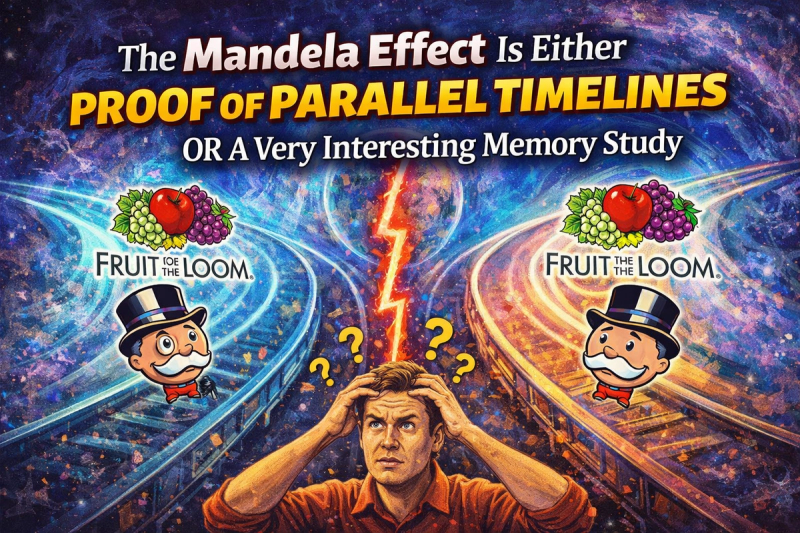
The Mandela Effect Is Either Proof of Parallel Timelines or a Very Interesting Memory Study
Thousands of people remember Nelson Mandela dying in prison in the 1980s. He did not. He died in 2013. Thousands of people remember the Monopoly Man wearing a monocle. He does not. Thousands remember it as the Berenstain Bears, spelled differently. The question isn't whether these people are wrong — they are. The question is why so many of them are wrong in exactly the same way.
Memory is not a recording. This is the first and most important thing to understand about the Mandela Effect. Human memory is reconstructive — every time you recall something, you're rebuilding it from fragments, and those fragments can be contaminated by subsequent information, social reinforcement, and simple pattern-matching. Your brain fills gaps with what seems most likely, and it doesn't always flag which parts are real versus filled-in. This is established neuroscience, not a fringe theory.
The parallel timeline hypothesis — that these false memories are bleed-through from alternate realities where things happened differently — is the internet's favorite explanation, and it's worth engaging with seriously rather than just dismissing. The many-worlds interpretation of quantum mechanics is real physics. The idea that alternative branches of reality exist is not obviously insane. What's missing is any mechanism by which a memory from one branch would contaminate consciousness in another, and any reason why it would specifically affect trivia about cartoon bears.
The cognitive explanation is robust: we remember categories, not details. The Monopoly Man wears a top hat and is associated with wealthy Victorian gentleman caricatures — a demographic that historically wore monocles. The brain fills 'Monopoly Man' with 'monocle' because it fits the pattern. Berenstain is an unusual spelling; Berenstein looks more like a familiar German-Jewish surname suffix. The brain 'corrects' it. These aren't signs of dimensional drift. They're signs of how memory actually works, which is both reassuring and slightly unsettling.
What the Mandela Effect is genuinely useful for — regardless of its cause — is as a demonstration that collective memory is not more reliable than individual memory. Large numbers of people being wrong about the same thing does not make them right. This is worth keeping in mind far beyond cartoon bears. The more interesting frontier is asking what it means that we trust our memories as completely as we do, given how much evidence we have that they're not what we think they are.
Go Deeper
Get the weekly PILLARS briefing. Research drops, case file updates, and stories that don't make the homepage.