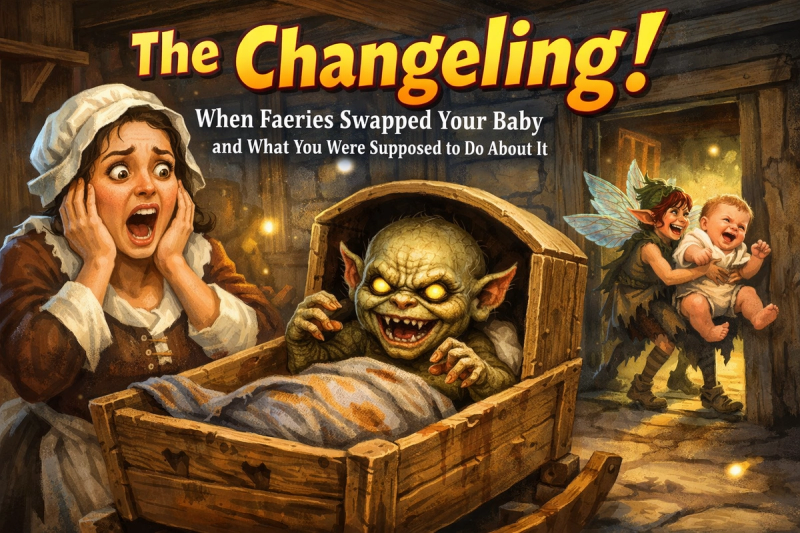
The Changeling: When Faeries Swapped Your Baby and What You Were Supposed to Do About It
Across Ireland, Scotland, Wales, Scandinavia, and most of continental Europe, there existed for centuries a shared and deeply serious belief: faeries would steal human children and leave a substitute in their place. The substitute — the changeling — would look almost like your child. But it wouldn't be. And there were very specific things you were supposed to do about it.
The changeling belief appears in written records as early as the 13th century and in oral tradition almost certainly before that. The classic scenario: a healthy infant is left unwatched, or taken outside after dark, or fails to be properly protected by iron or salt or a holy relic. When the parents return, the child seems different. Fussier. More withdrawn. Not developing normally. Not eating. Making sounds that aren't quite right. The explanation the culture offered was: this is not your child.
Modern scholars read this as a mythological frame for what we would now call developmental disabilities, autism spectrum conditions, failure to thrive, and postpartum psychosis. A parent who suddenly perceives their infant as foreign, unknowable, dangerous — that's a recognizable crisis. The folklore gave it a name, a cause, and crucially, a narrative that placed the blame outside the family. Your child was stolen. You were a victim. This is not nothing, psychologically speaking.
The prescribed remedies ranged from gentle to horrifying. Leaving the suspected changeling on a fairy mound overnight, so it could be reclaimed. Playing music that a faerie couldn't resist dancing to. Making the changeling laugh by doing something absurd — because faeries supposedly couldn't hide their delight at human foolishness. And, in the darkest versions: exposure, neglect, or worse, based on the belief that mistreating the substitute would cause the fae to return your real child. Some of these remedies killed children. This part of the history is not comfortable.
What the changeling myth preserves, underneath the tragedy, is something important about how stories function. Pre-industrial rural communities had no framework for neurodevelopmental difference, no language for postpartum mental illness, no resources for children who required intensive care. The story they built wasn't just superstition — it was a coping mechanism, a community explanation, and a map for navigating experiences that had no other map. Understanding where the story came from doesn't make it less fascinating. It makes it more.
Go Deeper
Get the weekly PILLARS briefing. Research drops, case file updates, and stories that don't make the homepage.